






What is a Karnaugh map used for in digital electronics?
A Karnaugh map, or K-map, is primarily used to simplify Boolean algebra expressions in digital circuit design. This visual method helps engineers and students minimize logic functions, reducing the number of logic gates needed. This simplification leads to more efficient, compact, and cost-effective electronic circuits, a crucial aspect for hardware development across the U.S.
How do you draw a 3-variable Karnaugh map?
To draw a 3-variable Karnaugh map, create a 2x4 or 4x2 grid, totaling eight cells. Label the rows and columns using Gray code sequences (e.g., 00, 01, 11, 10 for two variables on one axis and 0, 1 for the third variable on the other). Each cell corresponds to a minterm of the Boolean expression, into which you place a 0 or 1 from the truth table.
What are prime implicants in K-maps?
Prime implicants are the largest possible groups of adjacent '1's (or '0's) on a Karnaugh map, formed in powers of two. These groups cannot be expanded further without including '0's or violating adjacency rules. Identifying all prime implicants is essential for determining the most simplified Boolean expression, as they represent the maximal reduction of terms.
Can K-maps simplify expressions with 'don't care' conditions?
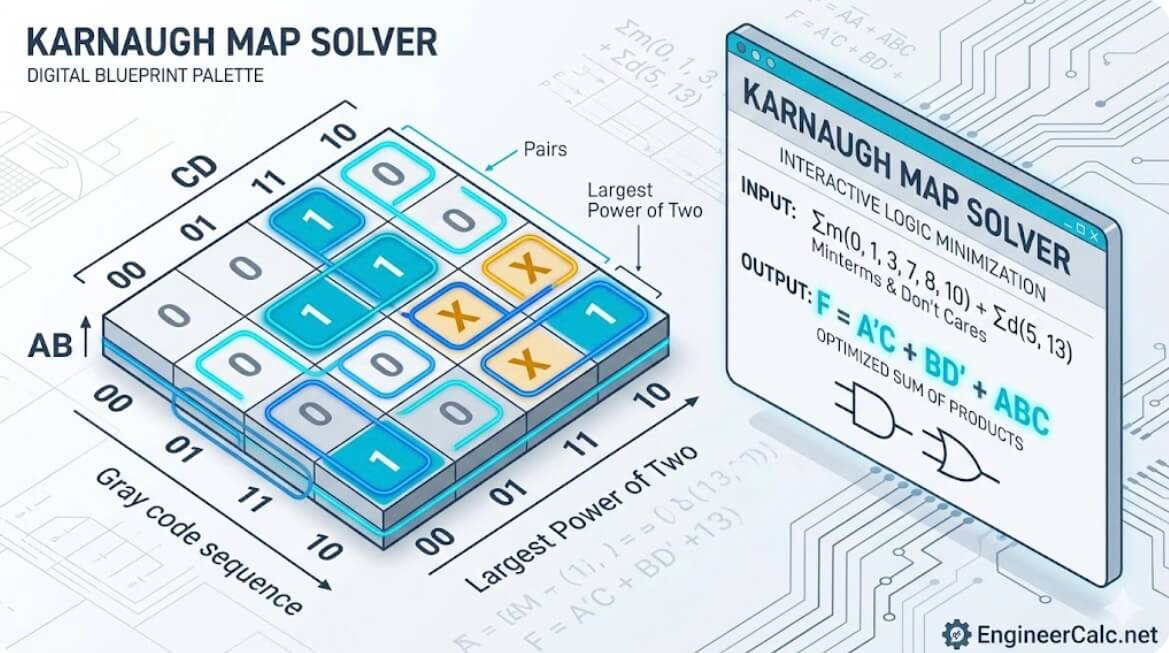
Yes, Karnaugh maps can effectively simplify expressions incorporating 'don't care' conditions, often denoted by 'X' or 'd'. These conditions represent input combinations where the output doesn't matter. You can strategically treat 'don't cares' as either '0's or '1's to form larger groups of '1's, thereby achieving greater simplification of the Boolean function.
What's the biggest advantage of using a Karnaugh map?
The biggest advantage of using a Karnaugh map is its visual simplicity and systematic approach to minimizing Boolean expressions. Unlike algebraic methods that can be complex and error-prone, K-maps allow designers to quickly identify and group terms graphically. This intuitive process significantly reduces the time and effort required to achieve optimal circuit simplification for digital designs.
Discover how a Karnaugh map, or K-map, serves as an essential visual tool for simplifying Boolean algebra expressions, a cornerstone of digital circuit design in the United States. This guide explains its practical applications, from optimizing logic gates to reducing hardware complexity and improving system efficiency. You will learn the systematic approach to constructing a K-map, the crucial rules for grouping adjacent terms, and how to effectively utilize "don't care" conditions for maximum simplification. We'll compare K-maps with traditional Boolean algebra, highlight common mistakes to avoid, and discuss available online tools that can assist in your design process. Whether you're a student learning digital electronics or an engineer streamlining complex systems, understanding the K-map is vital for creating robust and economical circuits. This resource provides actionable insights for anyone seeking to enhance their digital logic design skills.
What is a Karnaugh Map and How Does it Work?Demystifying the Karnaugh Map: A Core Tool for Digital Logic?
The Karnaugh map, often called a K-map, is a powerful visual tool that simplifies Boolean algebra expressions, a fundamental concept in digital circuit design. It helps engineers and students quickly reduce complex logic functions into their simplest forms, which is crucial for building efficient and cost-effective electronic systems. Understanding the K-map is key for anyone involved in computer architecture or hardware development.
For those in the United States working with digital electronics, the K-map offers a practical method to optimize logic gates, ensuring designs are as streamlined as possible. This simplification process translates directly into fewer components, lower power consumption, and more reliable circuits. It bridges the gap between theoretical Boolean logic and practical hardware implementation, making it an indispensable skill.
| Key Benefit | Description |
|---|---|
| Simplifies Boolean Expressions | Visually reduces complex logic to its simplest form. |
| Optimizes Digital Circuits | Leads to fewer logic gates and lower component count. |
| Reduces Design Errors | Provides a systematic way to minimize functions. |
| Faster Design Process | Quicker than algebraic manipulation for many cases. |
| Visual Clarity | Easy to see patterns for grouping and simplification. |
How Do You Construct a Karnaugh Map Effectively?
Constructing a Karnaugh map involves arranging a truth table's output values into a grid-like format. Each cell in the K-map corresponds to a specific combination of input variables, much like rows in a truth table. The cells are ordered using Gray code, ensuring that adjacent cells differ by only one variable, which is critical for simplification.
For a typical 2, 3, or 4-variable expression, you'll draw a rectangular grid with cells labeled according to Gray code sequences along the axes. For instance, with two variables (A, B), you'd have 00, 01, 11, 10. You then fill these cells with 0s or 1s based on the Boolean function's output for each input combination.
This systematic setup allows for the visual identification of patterns and groups of "1"s (or "0"s, depending on the approach). By correctly placing these values, you prepare the map for the crucial grouping step. A well-constructed map lays the groundwork for accurate and efficient logic simplification.
Always double-check your initial cell placements against the original truth table or Boolean expression. A single misplaced 1 or 0 can lead to an incorrect simplified function. Precision in this construction phase is truly a game-changer for digital designers aiming for optimal outcomes and avoiding costly rework.
| K-Map Variable Count | Grid Dimensions | Number of Cells |
|---|---|---|
| 2 Variables | 2x2 | 4 |
| 3 Variables | 2x4 or 4x2 | 8 |
| 4 Variables | 4x4 | 16 |
| 5 Variables (Advanced) | Two 4x4 layers | 32 |
What Are the Essential Rules for Grouping on a K-Map?
Grouping adjacent "1"s on a Karnaugh map is where the magic of simplification happens. The primary rule is to group powers of two: 1, 2, 4, 8, or 16 adjacent "1"s. These groups must be rectangular or square, and they can wrap around the edges of the map, like a cylinder or a torus.
Each group should be as large as possible, encompassing the maximum number of "1"s in a valid power-of-two shape. This ensures the greatest possible simplification. Every "1" on the map must be part of at least one group, but "1"s can be included in multiple groups if it helps make a larger group or cover another "1".
The goal is to cover all the "1"s with the minimum number of groups, with each group being as large as possible. This careful approach helps you derive the most simplified Boolean expression. Mastering these grouping rules is central to effectively using the Karnaugh map for your digital design projects.
How Do You Identify Prime Implicants and Essential Prime Implicants?
A prime implicant is a group of "1"s that cannot be combined with any other adjacent "1" to form a larger group. In simpler terms, it is the largest possible grouping for a set of "1"s. Identifying all prime implicants is a crucial step in the simplification process.
An essential prime implicant is a prime implicant that covers at least one "1" that no other prime implicant covers. These are non-negotiable and must be included in your final simplified expression. Missing an essential prime implicant can lead to an incomplete or incorrect function.
Systematically identifying all prime implicants first, then singling out the essential ones, is a robust strategy. After covering all "1"s with essential prime implicants, you then select the minimum number of remaining prime implicants to cover any uncovered "1"s. This methodical approach ensures an optimal solution.
| Grouping Rule | Description |
|---|---|
| Powers of Two | Groups must contain 1, 2, 4, 8, or 16 cells. |
| Rectangular/Square | Groups must form a continuous rectangular or square shape. |
| Wrap Around Edges | Groups can extend across map boundaries horizontally or vertically. |
| Largest Possible | Each group should be as large as validly possible. |
| Cover All Ones | Every '1' on the map must be included in at least one group. |
| Minimum Groups | Aim for the fewest possible groups to cover all '1's. |
What are "Don't Care" Conditions in Karnaugh Maps and Why Use Them?
"Don't care" conditions, typically represented by an 'X' or 'd' on a Karnaugh map, are output states for specific input combinations that don't matter to the design. This means the circuit's output can be either a 0 or a 1 for these particular inputs without affecting its core functionality. They often arise in digital systems where certain input combinations are impossible or irrelevant.
The real power of "don't cares" comes during the grouping process. You can strategically treat an 'X' as a '1' if it helps form a larger group of "1"s, leading to further simplification. Conversely, you can treat it as a '0' if it doesn't aid in forming a larger group, effectively ignoring it.
Utilizing "don't cares" allows you to achieve even greater minimization of your Boolean expression, resulting in more compact and efficient circuits. They provide a valuable degree of flexibility in digital design, making the Karnaugh map an even more versatile tool for optimization. Just remember to use them wisely to maximize simplification.
How Does a K-Map Compare to Boolean Algebra for Simplification?
While both Karnaugh maps and Boolean algebra simplify logic expressions, they offer distinct advantages. Boolean algebra relies on theorems and postulates, which can be abstract and sometimes cumbersome for complex expressions. It requires a strong grasp of algebraic manipulation and can be prone to human error if not executed carefully.
Karnaugh maps, on the other hand, provide a visual and systematic approach. They eliminate the need for remembering complex algebraic identities by allowing you to graphically identify redundant terms. This visual nature often makes K-maps quicker and less error-prone for functions with a modest number of variables (typically up to four).
For expressions with five or more variables, K-maps become unwieldy, and alternative methods like the Quine-McCluskey algorithm or specialized software are often preferred. However, for everyday digital logic design problems, especially in educational settings or for simpler circuits, the K-map remains a favorite due to its intuitive nature and efficiency.
Are There Online Tools or Software for Karnaugh Map Generation?
Absolutely, the digital age offers numerous online tools and software applications designed to assist with Karnaugh map generation and simplification. These digital aids can be incredibly helpful for students and professionals alike, especially when dealing with larger or more intricate Boolean expressions. Many platforms allow you to input your truth table or minterms directly, and they will generate the K-map and often provide the simplified expression automatically.
These tools can significantly speed up the simplification process and help verify manual calculations, acting as a handy double-check. Some popular options include free online K-map solvers available through a quick web search. They often feature interactive interfaces where you can visually experiment with grouping, reinforcing your understanding of the rules without the tedious manual drawing.
While digital tools are convenient, it's still essential to understand the underlying principles of the Karnaugh map. Relying solely on software without grasping the manual process can hinder your foundational knowledge. Use these tools as powerful assistants to enhance your learning and productivity, not as substitutes for comprehension, especially for those in digital design courses across the U.S.
What are Common Pitfalls to Avoid When Using Karnaugh Maps?
One common pitfall is failing to form the largest possible groups of "1"s. Remember, the goal is maximum simplification, which means making groups as big as they can possibly be (powers of two). Small, inefficient groups will lead to a less simplified, and thus less optimal, Boolean expression.
Another frequent mistake involves incorrect wrapping around the map edges or forming non-rectangular groups. The adjacency rule is strict: only cells differing by a single variable can be grouped. Always double-check that your groups adhere to the rectangular or square shape, even when wrapping.
Finally, forgetting to include all essential prime implicants or misidentifying them can lead to an incorrect final expression. Every "1" on the map must be covered, and some "1"s can only be covered by specific largest groups. A thorough review of your groupings against all original "1"s is always a good practice to catch these errors.
Why is it Important to Verify Your Simplified Expression?
Verifying your simplified Boolean expression derived from a Karnaugh map is a non-negotiable step in the digital design workflow. Even with the visual advantages of K-maps, human error can creep in during grouping or when transcribing the final equation. A single mistake could result in a circuit that doesn't function as intended, potentially leading to costly reworks or system failures.
One effective verification method is to compare the truth table of your original complex expression with the truth table generated by your simplified expression. If both truth tables produce identical outputs for all input combinations, then your simplification is correct. This methodical comparison ensures functional equivalence.
Another way to verify is to simulate the logic using software tools, or even build a small prototype if feasible, for critical parts of the design. This practical testing provides empirical proof that your simplified logic performs precisely as required. Investing time in verification ultimately saves time and resources down the line, a smart move for any US engineer.
FAQ: Your Top Questions About Karnaugh Maps Answered
What is the primary purpose of a Karnaugh map?
The primary purpose of a Karnaugh map is to simplify Boolean algebra expressions, making digital circuit design more efficient. It helps minimize the number of logic gates required to implement a function, leading to reduced hardware complexity, lower power consumption, and faster circuit operation. This visual method is crucial for optimizing combinational logic.
How many variables can a standard K-map handle?
A standard Karnaugh map is most effective for expressions with two, three, or four variables. While techniques exist for five or six variables (using multiple K-maps), they become increasingly complex and difficult to visualize. For more variables, software-based minimization methods like the Quine-McCluskey algorithm are generally preferred for accuracy and efficiency.
Can Karnaugh maps be used for sequential circuits?
Karnaugh maps are primarily designed for simplifying combinational logic circuits, not sequential circuits directly. Combinational circuits produce outputs based solely on current inputs, whereas sequential circuits depend on both current inputs and past states. While K-maps can simplify the combinational logic within a sequential circuit's design (e.g., next-state or output functions), they don't simplify the sequential nature itself.
Are there online tools to generate Karnaugh maps?
Yes, many free online tools and software applications are available to generate and simplify Karnaugh maps. These digital aids allow users to input truth tables or minterms and automatically produce the K-map and the minimized Boolean expression. They serve as excellent learning aids and verification tools, though understanding the manual process remains vital.
What is a prime implicant in a Karnaugh map?
A prime implicant in a Karnaugh map is a group of adjacent 1's that cannot be combined with any other adjacent 1's to form a larger group. It represents the largest possible valid grouping for a set of minterms. Identifying all prime implicants is a fundamental step towards finding the minimal Boolean expression for a given function.
Why are Gray codes used in K-map labeling?
Gray codes are used in Karnaugh map labeling to ensure that adjacent cells differ by only one variable. This property is critical because it allows for valid grouping of cells that are physically adjacent on the map, even when they appear at the map's edges. This single-variable change between adjacent cells is fundamental to the visual simplification process.